
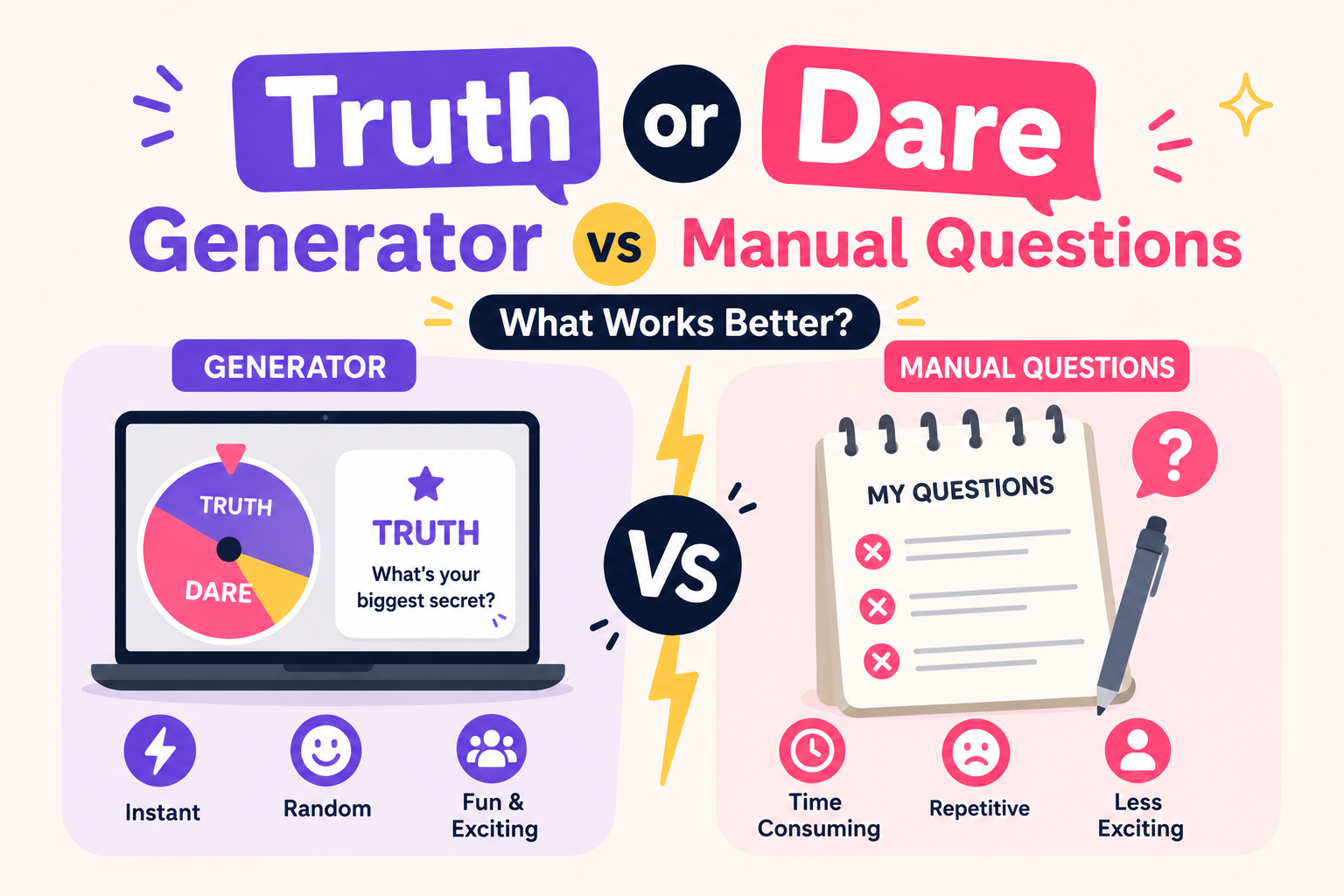
Stop overthinking it. Most people spend twenty minutes scrolling through “best questions” lists only for the vibe of the room to die a slow, painful death before the game even starts.
If you want the game to actually move, you need to decide right now: are you going to be the person frantically googling on your phone, or are you just going to let a system do the heavy lifting? Here is the reality of how these two methods actually play out in a real living room.
The Problem with Manual Questions (The “Uh… I Don’t Know” Factor)
We’ve all been there. It’s your turn to ask, everyone is looking at you, and your brain suddenly becomes a dial-up modem. You end up asking “What’s your favorite color?” for the third time because you’re terrified of being too intrusive or, worse, being boring.
Manual questions rely entirely on the creativity of the group. If your friends are funny and slightly unhinged, it works. If everyone is tired or just met, it’s a disaster. You run into the “safe zone” trap where nobody wants to ask anything spicy, and the game ends up feeling like a middle school orientation.
The Mental Load of Creativity
When you’re five drinks deep or just trying to relax, “being creative” feels like a job. Manual questions require you to:
- Assess the social boundaries of the person you’re asking.
- Remember if you’ve asked that before.
- Try to be “original” so you don’t look like a bore.
- Filter out the questions that are too weird.
That is a lot of cognitive heavy lifting for a game that is supposed to be about mindless fun. Most people eventually run out of steam after three rounds, and that’s when the phones come out—not to play, but to check Instagram because the game stalled.
Why a Truth or Dare Generator Usually Wins
Efficiency is underrated in social settings. When you use a truth or dare online tool, the “blame” is shifted. You aren’t the one asking the awkward question; the tool is. This creates a weird psychological loophole where people are more likely to answer honestly because it feels like part of the “system.”
The Psychology of “The Machine”
There is a strange phenomenon in social games: we forgive a computer for being intrusive, but we judge a friend for it. If Dave asks you about your most embarrassing dating fail, you might think he’s being nosy. If a screen tells you to answer it, you laugh and complain about “the algorithm” while actually spilling the tea.
It creates a “we’re all in this together” vibe. The tool becomes the common enemy or the chaotic neutral party guest that no one can stay mad at.
Variety You Can’t Fake
Even the most creative person has a “brand.” You know that one friend who always asks about exes, or the one who always dares people to do something gross with food. A generator breaks those patterns. It pulls from a database of thousands of prompts—ranging from the genuinely psychological to the physically ridiculous—that your brain simply wouldn’t think of at 11:00 PM on a Tuesday.
The “Human” Nuance: When Manual is Actually Better
Despite the convenience of tech, there are times when the human brain is better. If you have a very specific “inside joke” culture, a tool won’t know that Dave is terrified of pickles or that Sarah has a weird story about a 2014 Taylor Swift concert.
The Power of the Inside Joke
Manual questions are the king of hyper-specific scenarios.
“I dare you to call your brother and tell him you finally found the $20 you stole in 2012.”
A generator can’t do that. It can’t weaponize shared history. If your group has been friends for a decade, you have a vault of embarrassing secrets that a digital tool will never touch. In these cases, the tool should be your backup, not your lead.
Reading the Room
A human can tell when a “Truth” has hit a nerve that isn’t funny. If someone looks genuinely uncomfortable because a question touched on a recent breakup or a sensitive family issue, a human can pivot. A machine will just sit there with the prompt on the screen, oblivious to the fact that the vibe just turned icy.
Comparison: Speed, Quality, and Vibe
| Feature | Manual Questions | Truth or Dare Generator |
| Setup Time | 5-10 minutes of “thinking” | 2 seconds |
| Awkwardness | High (you have to own the question) | Low (the tool is the “bad guy”) |
| Creativity | Limited by your brain power | Practically infinite |
| Consistency | Hits and misses | Steady stream of quality |
| Flexibility | High (inside jokes) | Moderate (category filters) |
At some point, most people just switch to playing truth or dare game online instead of scrolling lists, simply because it keeps the momentum from stalling.
The “Middle Ground” Strategy (The Pro Move)
You don’t have to pick a side like it’s a blood feud. The best games usually start with a generator to break the ice and get everyone comfortable with being a little embarrassed. Once the energy is up and the stories start flowing, you can sprinkle in manual questions that play off what was just revealed.
How to Hybridize Your Game:
- The Icebreaker Phase: Use the generator for the first 20 minutes. It gets the “easy” stuff out of the way.
- The Deep Dive: When a truth reveal leads to a funny story, stop the tool. Ask follow-up questions manually.
- The “Emergency” Button: When the conversation dies down again, hit the generator to inject a fresh, random dare into the room.
Use the tech to ignite the fire, then use your brain to keep it burning.
Avoiding the “Cringe” Trap
The biggest risk with manual questions is the “Try-Hard” effect. Someone tries to be way too edgy or way too personal too fast, and the room gets quiet. It’s that awkward moment where a “fun dare” suddenly feels like a boundary violation.
Generators solve this with Category Filtering. Most tools have levels:
- Classic/Soft: Good for family or new acquaintances.
- Party: The sweet spot for friends and drinks.
- Extreme/Dirty: Only for the “no-boundaries” crowd.
This prevents that one guy from asking a “Truth” that belongs in a therapy session while everyone else is just trying to have a laugh. If you don’t want to think of questions every time, using a digital platform lets you set the “heat” level so things don’t get weirdly dark before the night has even peaked.
Why Manual Questions Often Fail in Large Groups
If you have more than five people, manual questions become a logistical nightmare.
- The Loudest Voice Wins: The same two people end up coming up with all the dares.
- The “Pass” Chain: If three people in a row can’t think of anything, the game is dead.
- Decision Fatigue: By the time it’s the eighth person’s turn, they’re just repeating what happened in round one.
In a large group, you need a central “referee.” A generator acts as that referee. It keeps the pace fast, ensures no one is being picked on unfairly, and keeps the prompts fresh enough that the 10th person is having as much fun as the 1st.
The “Search” Addiction: Why Manual Lists Suck
We’ve all seen the person who says “Wait, I have a list of good ones!” and then spends four minutes scrolling through a blog post of 300 questions.
The reality of “Listicles”:
- They are dated. Half the dares involve things like “planking” or “The Harlem Shake.”
- They are repetitive. You’ll see the same “who is your crush” question on every single site.
- They kill momentum. Reading a list isn’t playing; it’s researching.
A generator takes the best 1% of those lists and delivers them one by one. You aren’t reading; you’re reacting. That is the fundamental difference between a boring night and a memorable one.
Common Friction Points
Let’s be real about the downsides of the tech version. It’s not perfect, and ignoring its flaws is how you end up with a boring game.
- The “Context” Fail: Sometimes a generator gives you a prompt that makes zero sense for your environment (like “do a handstand” when you’re in a crowded booth at a bar).
- The “Skip” Rule: If you use a tool, you need a collective agreement on how many “re-rolls” someone gets. Without a skip rule, the tool can feel like a dictator. I usually recommend a “Two Skips per Person” rule to keep things fair but challenging.
- Phone Distraction: The danger of using a phone for the game is that someone will inevitably see a notification and disappear mentally for five minutes.
Pro-tip: Designate one “Game Master” phone. Turn on “Do Not Disturb” and put it in the middle of the table.
Setting the Stakes: Manual vs. Tech
One thing manual questions do well is “customized stakes.” You can say, “If you don’t do this dare, you have to buy the next round of drinks.”
With a generator, the stakes are usually “do it or you’re out.” To make the tool work better, you should attach manual penalties to it.
- The Penalty Box: If you skip a generator dare, you have to perform a “Standard Penalty” (like wearing your shirt backward for the rest of the night).
- The “Double Dare” Twist: If someone doesn’t like the generator’s dare, the group can manually “upgrade” it to something even crazier.
FAQ: What Actually Works?
Is it better to write questions on paper beforehand? Only if you have a lot of free time and want to feel like you’re back in 1998. It’s a nice touch for a curated party, but it lacks the spontaneity of a digital randomizer. Plus, someone always complains about the handwriting or the fact that they can see through the paper.
Can generators be too “generic”? They can be if you use a bad one. Look for tools that allow for deep categorization. If you’re playing with family, you don’t want the same prompts you’d use at a bachelor party. The “Classic” modes are usually safe, while “Extreme” modes are where the truly weird stuff lives.
What if the group is shy? Start with a generator on “Easy” mode. It lowers the barrier to entry. Shouting “Truth or Dare?” at a shy person is intimidating; letting them tap a screen is an invitation. It feels less like an interrogation and more like a game.
How do we handle “Dares” in public? Manual is usually safer here so you don’t get kicked out of a restaurant or arrested. However, a good tool will have a “Public” or “Party” setting that keeps things within the realm of legal and socially acceptable behavior.
How many people is too many for Truth or Dare? Once you hit 10-12 people, the rounds take too long. If you have a huge group, break into two smaller circles and use a generator for each. It keeps everyone engaged instead of waiting 15 minutes for their turn.
The Final Word: Just Hit the Button
The goal of Truth or Dare isn’t to show off how clever you are at coming up with questions. It’s to learn something weird about your friends and laugh at someone doing something ridiculous.
Manual questions are a “high-effort, high-reward” gamble. Sometimes they hit, but often they result in long silences and “I’ll just take a Truth… uh, what’s my favorite movie?”
A generator is a “low-effort, high-reward” guarantee. It handles the boring part (thinking) so you can get to the good part (the chaos). If you’re tired of the “I don’t know, you pick” loop, stop fighting the future. Pull up the tool, set your level, and let the chaos begin. You’re there to have fun, not to be a game show writer.