
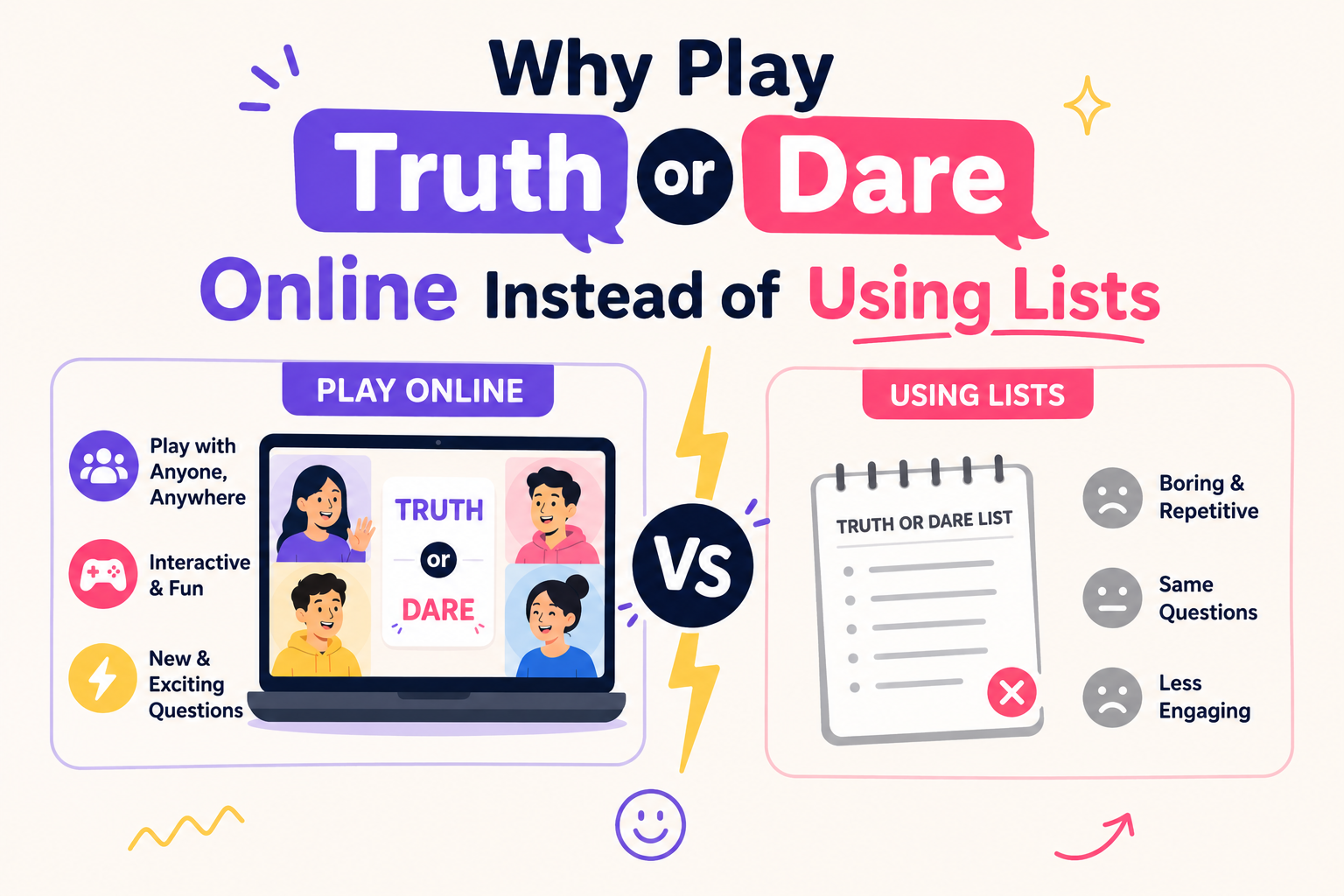
Most people think they just need a list of questions to get a game going. They spend twenty minutes scrolling through “Top 100 Truth or Dare Questions” blogs, only to realize half the prompts are cringey, outdated, or just don’t fit the vibe of the room. It’s a massive buzzkill.
If you’re still manually picking questions from a static list, you’re doing too much work for a game that’s supposed to be effortless.
The Friction of Static Lists
Static lists are where fun goes to die. You find a list, you start reading, and then you hit that awkward moment where you have to skip five questions because they’re either too “middle school” or way too intense for the current group. By the time you find a good one, the momentum is gone.
When you play truth or dare online, that curation happens instantly. You don’t have to act as the “game moderator” who filters out the boring stuff while everyone else waits around.
Why lists usually fail:
- The “Skip” Factor: You end up scrolling more than playing.
- Predictability: If everyone is looking at the same webpage, the “Truth” isn’t a surprise anymore.
- Vibe Mismatch: A list titled “Party Questions” might be 90% “What’s your favorite color?” which is barely a game.
Automation is Just Better
We automate everything else in our lives, so why are we still manual-laboring our party games? The logic is simple: a generator doesn’t have a bias. It doesn’t get tired of thinking, and it doesn’t accidentally suggest the same three questions because those are the only ones you can remember.
The “Deep Dive” Problem
I’ve noticed that when people use lists, they tend to get stuck in a loop. You pick a “category,” and then you’re forced to stay there because scrolling to a new category feels like a chore.
Online tools solve this by mixing the deck. You get a high-energy dare followed by a deep-thought truth without having to navigate three different submenus or scroll through 500 words of “Intro to Party Games” filler text.
| Static Lists | Online Tools |
| Requires manual scrolling | One-tap randomization |
| Easily “spoiled” by others looking | Pure surprise |
| Usually outdated or cheesy | Frequently updated prompts |
| High friction | Instant gameplay |
Psychology of the “Machine”
There’s a weird psychological trick that happens when a computer picks the dare. In a normal game, if I dare you to eat a spoonful of hot sauce, it feels personal. There’s a tiny bit of social friction because I chose that for you.
When an algorithm does it, the social tension vanishes. Everyone—including the person doing the dare—is on the same team against the “chaos” of the generator. It sounds small, but it’s the difference between a game that feels like a lighthearted hangout and one that feels like a passive-aggressive confrontation.
Leveling Up the Social Dynamic
There is a specific psychological shift that happens when a group looks at a screen together versus one person reading from a phone. It feels more like a “game” and less like an interrogation.
Most people find that the game keeps the pace moving fast enough that nobody has time to get “phone-snubbed” (where they start checking their own DMs because the game slowed down).
The awkwardness of “I can’t find a good one”
We’ve all been there. It’s your turn to pick a dare for someone, and you’re scrolling through a blog post, sweating because nothing is quite right. It makes the game feel heavy. A tool eliminates that “choice paralysis.” You get what you get, and the game stays snappy.
Why Variety Actually Matters
Human brains are pretty bad at being truly random. If you ask a friend to think of a dare, they’ll probably go for something involving a prank call or eating something weird. After three rounds, that gets old.
Online platforms have databases that go way deeper than your average person’s imagination. You get prompts you wouldn’t have thought of in a million years, which is exactly the point of playing in the first place. It forces you out of your comfort zone in a way that “User-Generated” ideas often fail to do.
The “Mood Mode” Advantage
Most static lists are a mess of different “levels.” You’ll have “What’s your favorite food?” right next to “Tell us your deepest, darkest secret.” It’s jarring.
Online generators usually have filters.
- Kids/Family: Safe for the living room with the parents.
- Soft/Chill: Good for new friends or icebreakers.
- Party/Wild: When the energy is high and everyone is comfortable.
- Extreme: Well, you know what that’s for.
You can’t “filter” a printed list or a 2,000-word blog post without doing a lot of mental heavy lifting. The tool does it for you so you don’t accidentally ask a coworker something that gets you a meeting with HR on Monday.
Better Accessibility (Even for Introverts)
Introverts often hate Truth or Dare because of the “Creative Pressure.” When it’s your turn to come up with a dare, your mind goes blank. You feel like you’re being judged for not being “fun” enough.
An online tool acts as a social crutch in the best way possible. It provides the creative spark so everyone can focus on the reaction rather than the planning. It lowers the barrier to entry so even the quietest person in the room can play without feeling like they need to be a stand-up comedian.
It’s About the Momentum
A party game lives or dies on momentum. The second people start debating which question is “better” or complaining that a list is boring, the energy in the room tanks.
The beauty of a tool is the “Next” button. If something doesn’t fit, you click a button and you’re onto the next thing in less than a second. No scrolling, no “wait, I lost my place,” and no awkward silences.
The History of Doing it Wrong
Truth or Dare has been around since the 16th century (back then it was called “Questions and Commands”). For 400 years, people had to use their own brains. We are the first generation that doesn’t have to.
Using a static list is basically just “16th-century style” but with a smartphone. It’s an outdated way to interact with a classic. If you’re going to use tech to play, use tech that actually enhances the experience rather than just digitizing a piece of paper.
Setting the Ground Rules
Even with a perfect tool, a game can go sideways if you don’t set boundaries. I always recommend the “Two-Strike Rule.”
- Everyone gets two “Skips” for the entire night.
- If you skip a third time, you have to do a “Penalty Task” (like being the designated drink-refiller for the next hour).
This keeps the game moving while ensuring nobody feels genuinely uncomfortable. A list can’t help you enforce rules, but a fast-paced generator makes people less likely to skip because the next prompt is only a second away.
Common Questions About Moving Online
Do I need an app for this? Not really. Most apps just clutter your phone and ask for permissions they don’t need. A web-based tool is usually the move because you can just pull it up in a browser and start playing.
Is it safe for all ages? It depends on the tool, but most good ones have “modes.” You can toggle between “Family” or “Party” so you don’t accidentally ask your cousin something you’ll regret hearing the answer to.
Can we play it over Zoom or FaceTime? This is actually where online tools shine. Trying to read a list to someone over a video call is clunky. Sharing a screen or just hitting “Randomize” and reading it out makes the virtual hang feel a lot more interactive.
What if the questions are too repetitive? That’s the risk with cheap lists. Real generators use large databases, so the odds of hitting the same question twice in one night are basically zero.
Does it work without Wi-Fi? Most web tools need a connection, but honestly, if you’re in a place with zero bars, you probably have bigger problems than finding a truth or dare prompt. For 99% of parties, the mobile browser works perfectly.
The Verdict
Stop wasting time on static lists that were written in 2012. If you want a game that actually works, keeps people engaged, and doesn’t require you to be a full-time moderator, just use the tool. It’s faster, it’s better, and it saves you from the inevitable “Is there a better list?” question.